Product Details
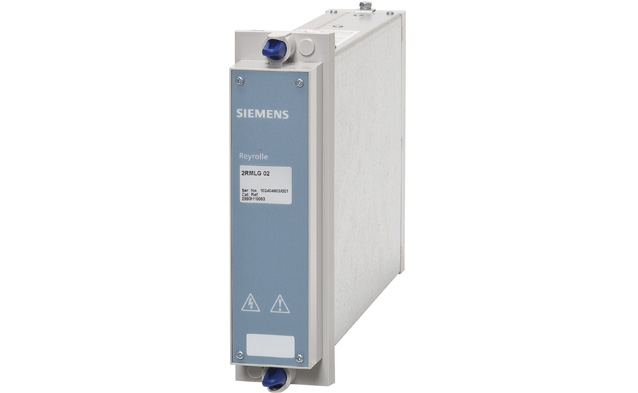
SIEMENS / REYROLLE 7XG22 – 2RMLG
Negotable
Transfer, Cash
1
Germany
The range of 2RMLG Test Blocks, housed within an
Epsilon enclosure, offers facilities for monitoring and
secondary injection testing of power system protection
schemes in conjunction with the 2RMLB-S multi-fingered
test plug.
The 2RMLG Test Block has 14 pairs of spring loaded
contacts which are linked to a terminal block positioned
at the rear of the enclosure.
The 2RMLG07 is coded to only accept the 2RMLB-S7 Test
Plug which has connection terminals 21, 23, 25 &
27, internally – For typical application see Fig 4.
The 2RMLG08 is coded to only accept the 2RMLB-S8 Test
Plug which has internal pairs 1& 3, 5& 7, 9& 11 and 15& 17
shorted together internally – For typical applications see
Figs 5, 6, 7 & 8.
The 2RMLG09 is coded to only accept the 2RMLB-S9 Test
Plug which has internal pairs 1-3-5-7, and 17-19 shorted
together internally.
Each pair of contacts is normally closed completing the
circuit through the test block when the associated
protection equipment is in use.
For testing purposes the test block can be accessed by
removing the front cover. The 2RMLG 01 has a metallic
probe attached to the front cover assembly which when
withdrawn open circuits the 2 contacts at position 13 and
14.
The main dc auxiliary supply to the protection scheme or
relay can be wired to this circuit to prevent inadvertent
tripping of the protection circuit after removal of the
cover and during the test procedure.
The 2RMLG 02/ 07/ 08/ 09 do not include the above facility
and contacts 13 and 14 are normally closed. These
contacts must not be used for current circuits, as the
relevant contact finger on the 2RMLB test plug is shorter
in this position.
The short test finger in position 13-14 on the 2RMLB will
open contacts 13-14 in the test block after the other
fingers have made contact in all other positions.
Description
Fig 1 & 2.
Note: It is important that the sockets in the test plug
( 2RMLBS-1) which correspond to the current transformer
secondary windings are linked prior to the test plug being
inserted into the test block.
This will ensure that the current transformer secondary
windings are short circuited prior to disconnection from
the protection scheme or relay ( as shown in Figure 3) .
If the dc auxiliary supply is to be used during testing it
can be linked using the sockets in the test plug.
Operation of the contacts can be monitored by connecting
the test equipment to the protection scheme or relay
with the even numbered sockets of the test plug.
If a number of 2RMLG test blocks are connected to a relay
it is recommended that the dc supply be routed through
each of them to safeguard against inadvertent operation.
Siemens Protection
© 2026 Copyright PT. Quinratu Karya Prisma by arFha. Page generated in 0.0012 seconds.